

From AI Projects to AI Transformation: A Practical Framework for Getting It Right
There is a pattern we see repeatedly in organizations running AI projects. The tech works. The pilot succeeds. And then, six months later, no one can quite explain what changed for the business.

Usually, the culprit is how the work around the AI was designed — or rather, was left undesigned. Most teams take an existing workflow, hand some of the steps to an AI system, and call it transformation. What they have actually built is a faster version of something that was already inefficient. The fundamental logic of the workflow with its handoffs, assumptions and bottlenecks, stays intact.
This is the gap the A.G.E.N.T. Framework was built to close. Developed by DAIN Studios and published in the Harvard Data Science Review, it is also taught in the Agentic AI leadership course developed with the Harvard Data Science Initiative, where senior leaders apply it to real challenges from their own organizations. The framework has five sections, each addressing a distinct reason why AI initiatives underdeliver.
[image: AGENT FRAMEWORK]
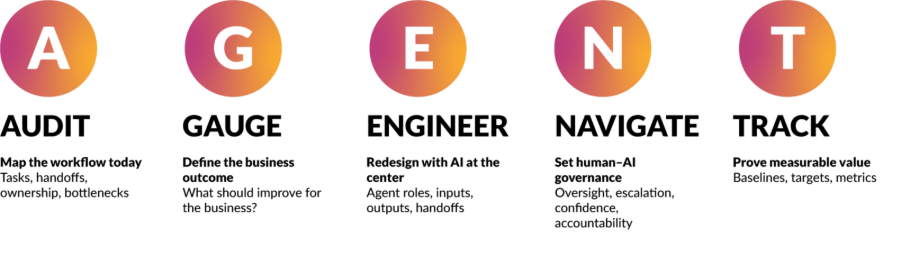
A — Audit: You probably don’t know your own process as well as you think
Before redesigning anything, you need an honest picture of how the workflow actually operates — not how it is documented, but how it is lived. Who really does what. Where the delays actually come from. What causes errors at the root, not at the surface.
This sounds straightforward, but teams regularly discover that their mental model of a process differs significantly from reality. Steps exist that nobody owns. Decisions get made informally that the official process doesn’t account for. The AUDIT replaces assumptions with facts, and it is the foundation everything else is built on.
G — Gauge: What does the business actually need to gain?
Teams often set out to make a process faster, or to reduce manual steps, and measure against those targets. But faster reports or fewer manual handoffs are outputs. They say nothing about whether the business is better off.
The GAUGE section forces a different conversation through a simple ”So What?” test: keep pushing any claimed benefit until you reach something that genuinely matters. ”We’ll complete this 3x faster.” So what? ”Staff spend less time on admin.” So what? ”We recover 20 hours of specialist capacity per week that goes back into client work.” Now you have something worth designing toward, and worth measuring when the project is done.
E — Engineer: What would this look like if you built it today?
This is the section where most teams realize how incrementally they have been thinking. The question in ENGINEER is what the workflow would look like if you were building it from scratch, knowing what AI agents can do.
The answer is usually quite different from what you have now. AI agents can run multiple threads simultaneously. They don’t need handoffs in the same way humans do. They can make consistent decisions at volume without fatigue. A workflow designed around human limitations and then partly automated is a different thing entirely from a workflow designed for AI agents from the start. The difference between 10–30% productivity gains and 2–10x transformation almost always comes down to whether this question was asked seriously.
N — Navigate: Who is accountable when something goes wrong?
Once AI agents handle significant parts of the work, a harder question emerges: who is responsible when something goes wrong? And how do you decide which decisions the AI can make on its own versus which ones genuinely need a human?
Two failure modes appear consistently here. The first is over-control — requiring humans to approve every AI output, which means you have added a step rather than removed one. The second is under-control — AI operating without any real oversight, which creates risks that most organizations, particularly in regulated industries, cannot accept. The goal is to be deliberate about each decision in the workflow: which ones genuinely require human judgment, and which ones can be handled within defined parameters?
T — Track: Would your CEO actually believe these numbers?
Most AI measurement ends up tracking whether the system is running: tasks completed, response times, error rates. Useful for the technical team, but they don’t answer the question a senior leader will eventually ask: did this change anything for the business?
The practical test is simple: show the metrics to someone accountable for business outcomes and ask whether they find them convincing. TRACK maps every metric back to the outcomes defined in GAUGE and assigns ownership, so when the numbers come in, someone is responsible for them.
If your organization has an AI initiative underway, the five questions above are worth asking before the next project review. They tend to surface the gaps that are easiest to fix early and hardest to fix later. DAIN Studios works with organizations across Europe to apply the A.G.E.N.T. Framework in practice. Get in touch if you want to explore what that looks like for your context.
DAIN Studios is an AI consultancy based in Helsinki, Berlin and Munich. The A.G.E.N.T. Framework was published in the Harvard Data Science Review (Kruhse-Lehtonen & Hofmann, 2026) and is taught in the Harvard Data Science Initiative’s Agentic AI leadership course.
More Information
Ulla Kruhse-Lehtonen
CEO of DAIN Studios Finland, Co-Founder