

Avaus learnings and best practices from running AI programs for growth

Most AI programs fail because nobody designed the program around the model to reach scale. An AI program for growth is a structured operating rhythm, not a project plan: a defined cadence of sprints, a three-tier steering system, a prioritized use case funnel, and four backlogs that move together instead of one after another. Get that structure right and the pace compounds. Get it wrong and you stall at the first ten use cases, no matter how good your data team is.
We’ve now run this rhythm across engagements at different scales, from a bigger three-year, six-market commercial transformation to a one-year rebuild of a small but regulated loan broker’s entire data foundation. The patterns repeat. This blog will try to pull together what we’ve learned running AI programs for growth, grounded in two of those engagements: Dustin, the Nordic IT distributor running its Commercial AI Program (CAP), and Enklare, the Swedish loan broker that went from unused data to three machine learning models and roughly fourteen mapped use cases in a year.
The operating model, in brief
We design and run AI programs against an eight-dimension operating model, A through H: Targets, Strategies, Structures, Use case implementation, Capabilities, Governance, Measurement, and Change management. Forty building blocks in total, each one a testable question about whether your organization is ready to turn AI into commercial results. What matters for this post is how three parts of that model work together in practice: the delivery rhythm, the steering cadence, and the use case funnel.
The rhythm: 12-week increments, six sprints
Use case development runs in 12-week increments, split into six two-week sprints: DESIGN, then four BUILD sprints, then REPORT. Three lanes run in parallel through every increment: Capability (infrastructure and platform work), Use case development (design, build, deploy, monitor), and Scale (expansion, rollout, optimization).
The rhythm sounds simple. What makes it work is that a fixed twelve weeks forces prioritization decisions instead of letting them drift. You can’t quietly extend a design phase by a month when the calendar says REPORT is in week eleven. At Dustin, this rhythm has now run long enough that the three-month planning phase at launch evolved into two half-year planning cycles with quarterly calibration, and roughly five core use cases per quarter produce twenty to thirty automations a quarter between them.
Three horizons of steering, not one status meeting
Programs that rely on a single monthly check-in lose the thread fast, because a strategic sponsor and a data engineer need completely different information at completely different speeds. We run three steering cadences at once:
Strategic, every two to three months. Board members, P&L leads, and the program sponsor connect progress and resourcing back to business goals.
Tactical or operational, every two to three weeks. Data, sales, marketing, and commercial leads guide the day-to-day direction and clear blockers.
Core team, daily. Data engineers, data scientists, and architects doing the actual build.
The use case funnel: from 250 ideas to a working shortlist
Every program starts with more ideas than anyone can build. We run those ideas through a three-stage funnel, scored on ICE: Impact, Confidence, Effort.
Extended list, roughly 250 use cases. Everything possible, unfiltered.
Long list, roughly 50 to 100. Scored for feasibility and priority.
Short list, roughly 10 to 20. Prioritized for near-term delivery.
A long list of 100 to 150 is normal for a program spanning multiple markets and both online and relational sales. How you cut the list matters as much as how you score it: one telco client clustered every use case tied to a single data source, so that unlocking one source unlocked a whole family of use cases at once. The funnel gets revisited every planning cycle as new evidence comes in from what’s already live, never treated as a one-time exercise.
The best practice that separates the programs that scale
Almost every company we meet sequences the work: get the data foundation right first, then start building use cases, then worry about organizational change once something is live. It feels responsible. It is also why most AI programs stall somewhere around use case ten or fifteen and never get past it. Some never make it out of the data foundation phase.
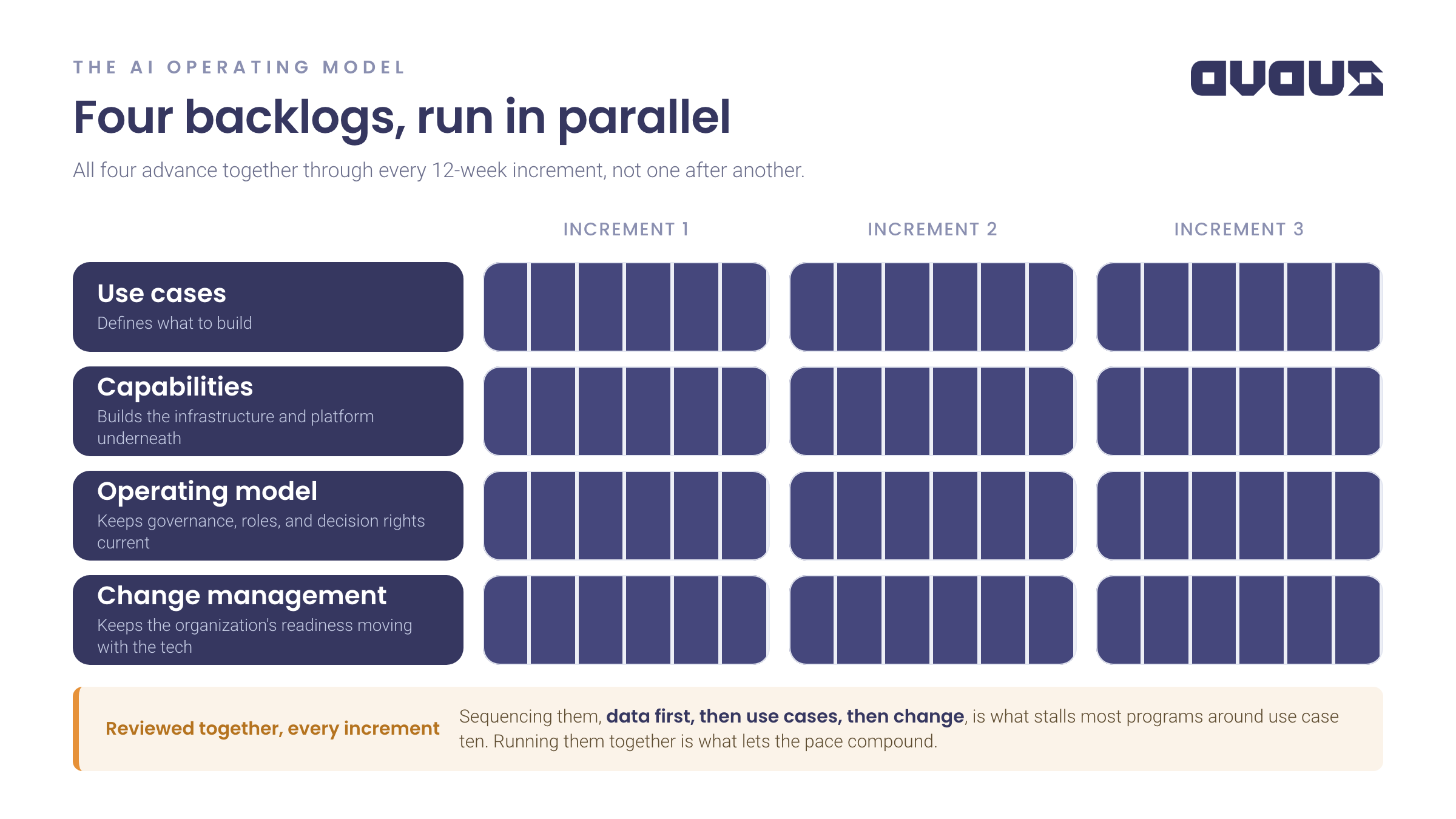
We run four backlogs in parallel from day one, not one after another: use cases, capabilities, operating model, and change management, all reviewed together every increment. The use case backlog defines what to build. The capability backlog builds the infrastructure and platform underneath it. The operating model backlog keeps governance, roles, and decision rights current as the program grows. The change management backlog keeps the organization’s readiness moving at the same pace as the technology.
The logic: a use case doesn’t wait for perfect data infrastructure to exist, because if it did, you’d never ship anything in year one. But it also can’t outrun the organization’s ability to use what gets built, or you end up with automations nobody trusts and nobody adopts. Running all four backlogs together is what lets pace compound instead of resetting at every phase gate. Parallel backlogs only stay coherent if the documentation connecting them is kept current in real time, not written up after the fact.
The results back it up. Dustin went live with fifty automations in the first six months of active implementation, on track for roughly one hundred in year one, ahead of the original program target. Use case development output increased 170% from Q1 to Q2 alone, the direct result of capability, governance, and change work maturing at the same pace as the use case pipeline instead of trailing behind it.
Enklare: the same discipline, a different starting point
Not every program starts at Dustin’s scale, and the discipline holds regardless. Enklare, a Swedish loan broker operating under a banking license, came to us with a large data asset that had never been put to work and a stalled AI pilot that left no reusable infrastructure behind. Erik Wegnelius, CEO at Enklare, put it plainly: ”We had large amounts of data that were largely unused. We also had plenty of ideas, but we lacked the capabilities and expertise to turn that data into something meaningful.”
We started with a prestudy: targets, strategy, and roadmap defined before any building began, which mattered doubly given the regulatory bar a banking license puts on governance. From there, Enklare built a composable data architecture with decoupled services. Automated MLOps pipelines and Reverse ETL now push model predictions continuously into its marketing platforms. Within a year the team had built three machine learning models and mapped roughly fourteen use cases across commercial and operational areas.
The explicit goal throughout was capability transfer, not dependency. Enklare’s own team was onboarded gradually across the engagement, and Fabian Bratell, Product Manager for Automation and AI Enablement at Enklare, named exactly what made the difference: ”The biggest value has definitely come from the ’ways of working’ piece, or the Operating Model. How you source use cases, assess their value, prioritise between them, how you govern progression and prioritisation. That I’d say is by far the biggest contribution, the thing that now enables us to run this internally.” Enklare now sources, prioritizes, designs, and implements use cases on their own, with AI established as a board-level strategic priority rather than a standalone project.
Two different companies, two different scopes, and the same underlying practice: parallel backlogs, a steering cadence that matches the pace of decisions to the people making them, and a use case funnel that keeps getting revisited. The ways of working travel beyond AI programs too. The CIO of one steel company client told us: ”Avaus way of working was so efficient that we asked them to consult us on how to be more efficient in our 85 MSEK ERP initiative.”
Common questions
How long does it take to see results from an AI program built this way?
At Dustin, the first fifty automations went live within six months of active implementation, following a three-month planning phase. Enklare built three machine learning models and mapped roughly fourteen use cases within twelve months, starting from unused data and no ML capability. Timelines depend on starting maturity, but both programs show measurable commercial results inside the first year.
Why run four backlogs in parallel instead of sequentially?
Because sequencing them, data first, then use cases, then change management, creates a program that either never ships (waiting for perfect infrastructure) or ships automations the organization isn’t ready to adopt. Running use cases, capabilities, operating model, and change management together keeps delivery and organizational readiness moving at the same pace, which is what allows results to compound instead of resetting at every phase.
What’s the difference between a use case long list and a short list?
The long list is roughly 50 to 100 use cases scored for feasibility and priority using ICE (Impact, Confidence, Effort). The short list narrows that to roughly 10 to 20 use cases prioritized for near-term delivery. Both are revisited every planning cycle as evidence comes in from what’s already live, not set once and left alone.
Where is your growth, not just your efficiency?
If your AI program is generating cost savings but you can’t point to incremental revenue, that’s usually a sign the operating model, not the technology and it needs attention.
More Information
Claes Kaarni, Managing Director, Avaus Finland
Claes is the Country Head and Managing Director of Avaus Finland, with over 20 years of experience in software development, data, and AI business. Grounded in this experience, he brings insight into how data, automation, and AI can be turned into real business value, highlighting what this requires in practice. Claes is a growth-obsessed leader who thrives on helping organizations and people get to their full potential through technology and a growth mindset.
Avaus helps enterprises increase the share of data-driven and automated processes in sales and marketing. With a proven methodology covering both technology and change management, and a performance-based commercial model, Avaus supports clients in turning their existing data into measurable business results. Avaus operates from offices in Helsinki, Stockholm, and Munich.